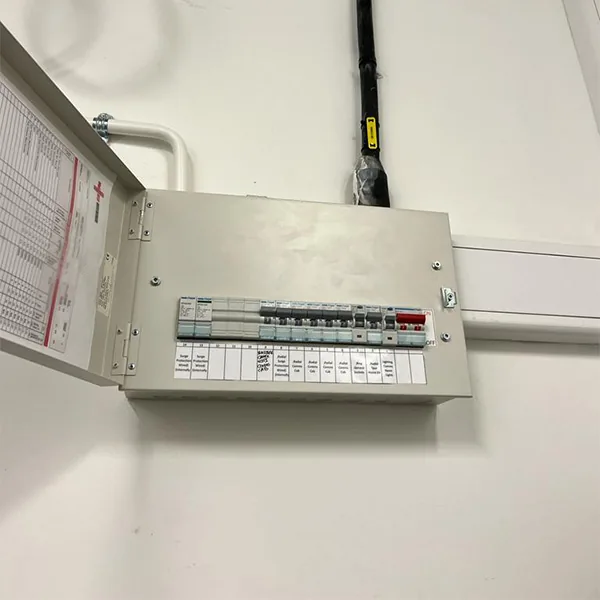
If your consumer unit is wooden-backed, has rewireable fuses, or has no RCD protection, it is past time for an upgrade. A modern 18th Edition RCBO-per-circuit board protects every circuit independently, satisfies current regulations, and typically costs £650 to £1,200 plus VAT fitted with full testing and NAPIT notification. Most jobs take two to four hours on site.
Your consumer unit (still called the fuse box in some homes) is the most important piece of electrical kit in your house. It is the single point that decides whether a fault in one socket trips one circuit, or whether the whole installation drops and you are trying to find a torch at 11pm. If yours is old, this article walks you through when it really is time to upgrade and what a modern board actually does differently.
Signs Your Consumer Unit Needs Replacing
A consumer unit does not normally die a clean death. The signs that it should be changed are quieter than that. Here is what we look for on a survey in Edinburgh, the Lothians, Fife or Glasgow.
- Wooden back board, ceramic fuses or rewireable fuses. These pre-date 1990s practice and almost always lack proper RCD protection.
- No RCDs at all. RCDs (residual current devices) trip when there is a leak to earth, the thing that kills people. A board without any is not 18th Edition compliant.
- A single big RCD splitting the whole house. Better than nothing, but one fault on the cooker can take down the whole house. Modern boards use one RCBO per circuit instead.
- Things trip and you cannot tell why. Old boards often share circuits between rooms, so when something faults you cannot isolate it cleanly.
- Buzzing, charring or warmth at the board. Stop using the board. Call us. Do not poke around.
- Your last EICR (electrical safety report) came back with a C2 on the consumer unit. That is the formal "this is not safe enough" code and it has to be remedied before the report can be marked satisfactory.
What an RCBO-per-Circuit Board Actually Does
An RCBO is a Miniature Circuit Breaker (overload protection, like a fuse) and a Residual Current Device (earth-leakage protection, the one that saves a life) combined into a single module on a single circuit. Old "dual-RCD" boards split the house into two halves, so a fault on the freezer can drop the lights too. RCBO-per-circuit boards do not. A fault on one circuit only trips that circuit.
Practically: if the immersion develops an earth fault while you are away on holiday, only the immersion is off when you come back. The fridge and the freezer have stayed on. That is the change.
What Happens On Install Day
- We agree a time and tell you the power-off window. Most jobs are two to four hours. We will not turn up at 9am and leave you in the dark until 4pm.
- We isolate the supply at the cutout / meter tails. Where the supply needs to be isolated by the Distribution Network Operator, we book that ahead.
- Old board off, new board on. Existing circuits are landed on individual RCBOs, every conductor is identified and labelled.
- We test every circuit before re-energising. Insulation resistance, continuity, polarity, earth-fault loop impedance and RCD trip times for each one.
- You get the Electrical Installation Certificate the same day. Notification goes to building control through our NAPIT scheme automatically.
What It Costs
Most consumer unit upgrades in our area land between £650 and £1,200. The price depends on the size of the board (number of circuits), whether surge protection is added, and whether testing flags anything that needs putting right at the same time. We quote in writing after a free survey.
- Small flat, 6 to 8 circuits, RCBO board, no surge: usually £650 to £800.
- Average family home, 10 to 12 circuits, RCBO board, Type 2 surge: usually £900 to £1,100.
- Larger property, 16+ circuits or remedial wiring tidy-up: quoted on survey.
Klarna finance is available on consumer unit work over £500, so the cost can be spread.
Planning a Consumer Unit Upgrade?
Chris and Carlos quote consumer unit upgrades across Edinburgh and the Lothians from £650 to £1,200, including testing and NAPIT notification.
Call for a Free QuoteWhy NAPIT Notification Matters
Changing a consumer unit is "notifiable work" under Scottish building regulations. That means a building-control body has to know about it. There are two routes: the homeowner can apply to local-authority building control and pay them (usually a few hundred pounds), or a registered electrician can self-certify through their Competent Person Scheme. We use NAPIT, so the notification, the certificate and the lodgement happen as part of the job. There is nothing for you to file.
Frequently Asked Questions
Two to four hours typically, agreed with you up front. We coordinate it around freezers and work-from-home meetings.
You can keep an existing dual-RCD board if it is in working order, but if you are paying for a new board it makes no sense not to specify RCBOs. Individual-circuit protection is the modern default.
The current regulations require risk assessment. We recommend it on any property with expensive electronics, smart-home kit, or a heat pump or solar inverter. The cost is modest at the time of a board change and prohibitive to retrofit later.
Usually, yes. We test every circuit before re-energising. If something fails we explain it, quote the remedial work, and only do it with your sign-off.